Whether a treble hook is good or not, and whether the hook-up rate and fish loss rate are high, mainly depend on these six factors: strength, sharpness, coating, wire diameter, weight, and size.
Treble hook strength
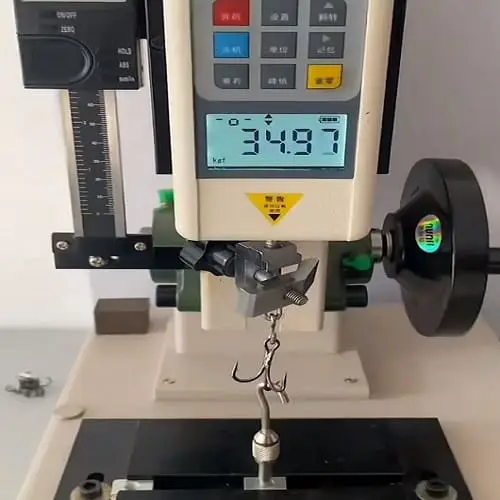
Strength is determined by the raw materials and quenching process, maintaining the hardness and rigidity of the hook. Toughness is determined by the tempering process. The toughness of the hook directly determines its tensile strength. Strength and toughness are contradictory: high strength with low toughness makes the hook prone to fracture; low strength with high toughness makes the hook prone to deformation and bending, but with greater tensile capacity. A good hook is the result of balancing the contradiction between strength and toughness to an optimal state. Hard but not brittle, tough but not soft, transforming contradiction into mutual complementarity.
Treble hook sharpness
Sharpness is determined by different hook point types, such as Hand Grinded Point, Cutting Blade, Cutting Point, and whether a chemical sharpening process is applied. For small-sized fish, Needle Point can be selected; when targeting heavy fish or fish with thick lips, choose Hand Grinded Point or Cutting Blade. This directly affects the penetration time into the fish mouth and the penetration depth. For fish with harder oral structures, using a Needle Point can only pierce the surface tissue of the mouth and cannot penetrate deeper, which easily leads to fish loss.
Treble hook coating
The coating of the hook is a key focus of promotion by various hook manufacturers, as it relates to the smoothness of the hook, namely, the smoothness during penetration. When testing two different coatings, the difference can definitely be perceived. This can also be fully sensed by touching the wire diameter by hand. Anglers who frequently target large fish can understand the importance of penetration performance: the larger the fish, the denser and thicker the flesh. Wire diameter, coating, and hook point directly determine whether the hook can instantly penetrate and then fix the load point at the center of the hook gap.
Treble hook wire diameter
Wire diameter varies in thickness, which is referred to by suppliers as multiple-strength reinforcement. Choose according to your requirements. Thick wire diameter has high strength, average penetration, and average toughness, suitable for use under high drag settings. Its sharpness is inferior to thin wire diameter, suitable for targeting large fish with heavy line and stiff rods. Thin wire diameter has average strength and is prone to deformation, but offers good penetration and toughness, suitable for light line and soft rods.
Treble hook weight
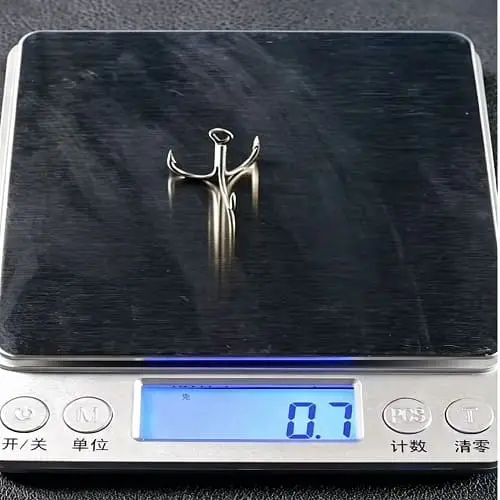
Weight is related to the size of the hook and the thickness of the wire diameter. The swimming action of lures underwater is designed and calibrated. If the weight of the treble hook exceeds the original hook by too much, it will definitely affect the lure action. Metal lures are less affected, but for plastic lures such as minnows, pencils, and poppers, the difference in action will be very significant.
Treble hook size
The larger the treble hook, the less likely the fish is to escape. After fully penetrating the fish, the load point is at the center of the hook gap, which can lock the fish more securely. Even if the fish struggles, the larger gap reduces the chance of slipping. Smaller hooks are more likely to result in fish loss, as they are less likely to fully penetrate after hooking, and the larger the fish, the easier it is to escape. This is because the hook shank is too short and the gap is too narrow to achieve full penetration. Even if fully penetrated, the fish can easily break free from the gap when struggling.